

 0
0
 0
0
Facing tax debt can feel overwhelming, especially when collection notices arrive and penalties continue to accumulate. A tax resolution group specializes in helping individuals and businesses navigate these challenging situations by negotiating with the IRS and state tax agencies on behalf of taxpayers. These professionals understand the intricacies of tax law, available relief programs, and the best strategies to minimize financial burdens while achieving compliance. Whether you're dealing with unpaid back taxes, unfiled returns, or an aggressive collection action, understanding how a tax resolution group operates can be the first step toward financial recovery and peace of mind.
Understanding What a Tax Resolution Group Does
A tax resolution group provides specialized services designed to address various tax-related problems that taxpayers face. These organizations employ tax attorneys, enrolled agents, and certified public accountants who possess deep knowledge of IRS procedures and tax code regulations.
The primary function centers on representing clients during negotiations with tax authorities. This representation includes communicating directly with IRS agents, preparing necessary documentation, and advocating for the most favorable settlement terms possible. Many taxpayers find the process intimidating, which is where professional assistance becomes invaluable.
Core Services Offered
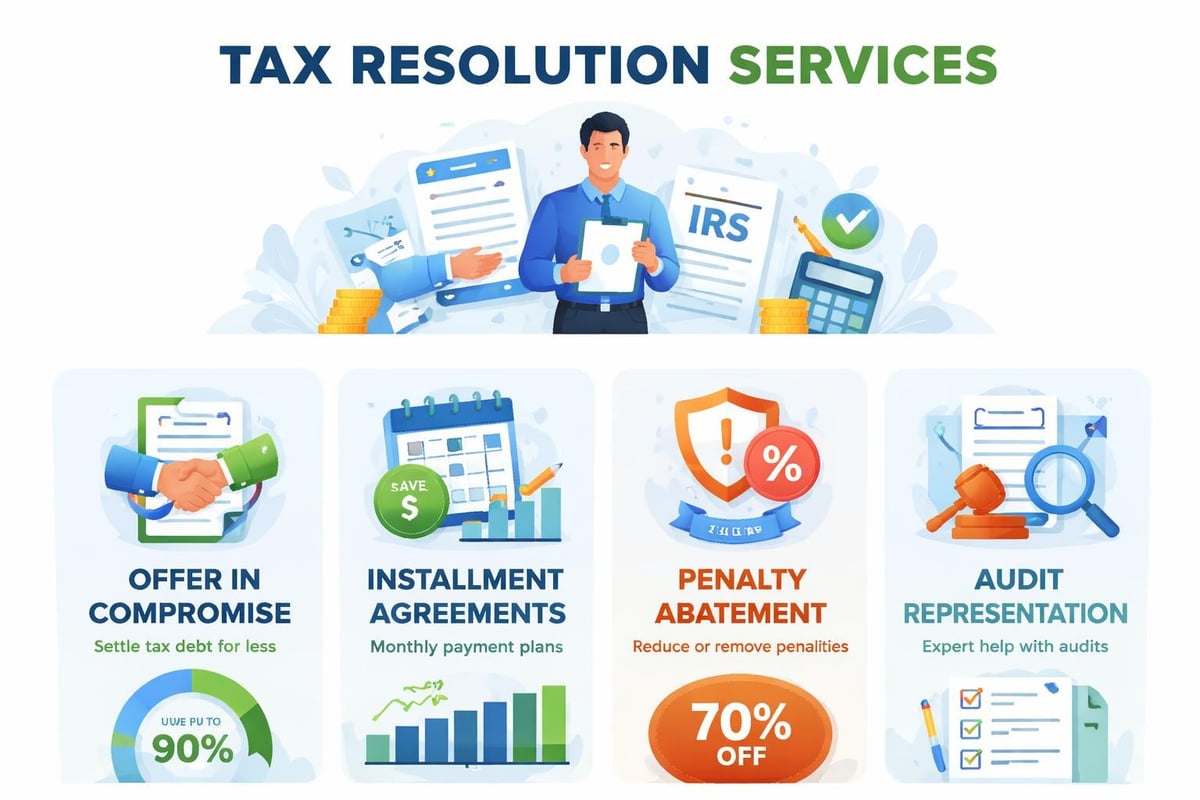
Professional tax resolution groups typically offer a comprehensive range of services:
- Offer in Compromise negotiations to settle tax debt for less than the full amount owed
- Installment agreement arrangements that establish manageable monthly payment plans
- Currently Not Collectible status applications for taxpayers experiencing financial hardship
- Penalty abatement requests to reduce or eliminate IRS penalties
- Audit representation to protect taxpayers during IRS examinations
- Innocent spouse relief applications for individuals unfairly burdened by a spouse's tax debt
- Lien and levy releases to remove or prevent wage garnishments and asset seizures
The tax resolution process requires thorough financial analysis and strategic planning. Professionals examine your complete financial picture, including income, expenses, assets, and liabilities, to determine which relief options provide the best outcome.
When You Need Professional Tax Resolution Help
Recognizing when to seek assistance from a tax resolution group can make the difference between a manageable situation and a financial crisis. Certain circumstances demand immediate professional intervention.
Back tax debt exceeding $10,000 often warrants professional help. At this threshold, the IRS becomes more aggressive with collection actions, and the complexity of resolving such debt increases substantially. Self-negotiation rarely produces optimal results in these cases.
Warning Signs That Require Immediate Action
Several situations indicate urgent need for professional representation:
- Receipt of IRS levy notices threatening wage garnishment or bank account seizures
- Tax liens filed against your property damaging credit and limiting financial options
- Criminal investigation notifications requiring immediate legal defense
- Multiple years of unfiled returns creating compound penalties and interest
- Revenue officer assignment indicating escalated collection enforcement
Business owners face additional complexities when payroll tax issues arise. The IRS treats unpaid employment taxes with particular severity, often pursuing business owners personally for these debts. A tax resolution group understands the dispute resolution options available and can navigate these treacherous waters effectively.
The Independent Office of Appeals provides another avenue for resolving disputes, and experienced professionals know how to present cases most effectively to appeals officers.
Evaluating Tax Resolution Group Credentials and Expertise
Not all tax resolution providers operate with equal competence or ethical standards. Selecting the right tax resolution group requires careful vetting and understanding of professional qualifications.
Professional Credentials That Matter
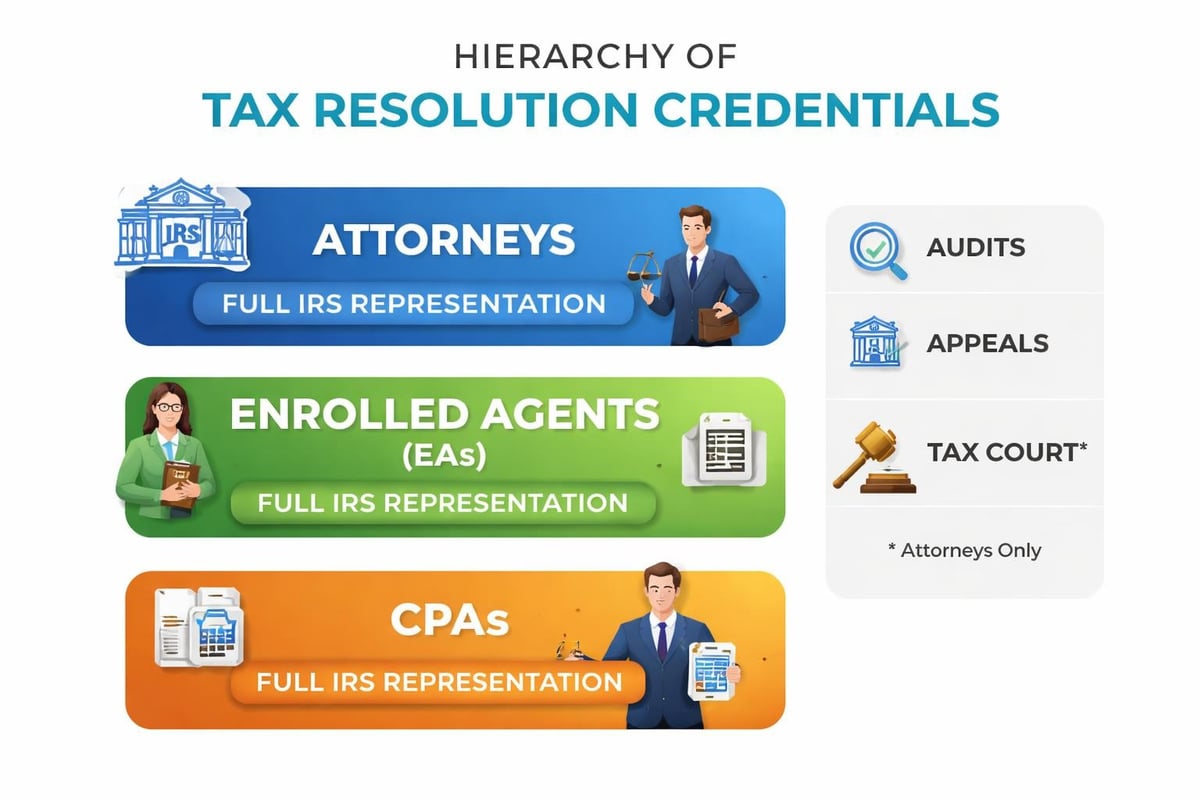
| Credential | Description | Authority Level |
|---|---|---|
| Tax Attorney | Licensed lawyer specializing in tax law | Can represent in all IRS matters and Tax Court |
| Enrolled Agent | IRS-licensed tax practitioner | Can represent in all IRS matters |
| CPA | Certified Public Accountant | Can represent in IRS matters with proper authorization |
| Unlicensed Preparer | No professional credential | Cannot represent before IRS |
The qualification differences matter significantly. Tax attorneys can provide legal privilege protection for communications and represent clients in complex legal proceedings. Enrolled agents specialize exclusively in taxation and pass rigorous IRS examinations. CPAs bring accounting expertise but may lack specialized tax resolution experience.
Red flags to watch for include guarantees of specific outcomes, requests for large upfront fees before case analysis, and promises to settle debts for "pennies on the dollar" without reviewing financial circumstances. Legitimate providers, like CLAW Tax Group, conduct thorough case evaluations before discussing potential outcomes.
Questions to Ask Before Hiring
Before committing to a tax resolution group, request detailed information:
- What specific credentials do assigned team members hold?
- How many cases similar to mine have you resolved?
- What is your fee structure and payment policy?
- Will you provide a written engagement agreement?
- Can you supply client references or testimonials?
- What is your communication policy and expected response time?
Transparency in answering these questions indicates professionalism and ethical practice. Evasive responses or high-pressure sales tactics suggest you should continue your search.
Common Tax Resolution Strategies and Their Applications
A tax resolution group employs various strategies depending on individual circumstances. Understanding these approaches helps taxpayers make informed decisions about their situations.
Offer in Compromise: Settling for Less
The Offer in Compromise (OIC) allows qualifying taxpayers to settle their debt for less than the full amount owed. The IRS accepts offers when the amount represents the maximum collectible based on the taxpayer's financial situation.
Qualification requires demonstrating one of three conditions:
- Doubt as to collectibility: The taxpayer cannot pay the full amount within the collection statute
- Doubt as to liability: Legitimate dispute exists regarding the tax debt's validity
- Effective tax administration: Exceptional circumstances make full payment inequitable
The acceptance rate for OIC applications remains relatively low, typically around 30-40%. A tax resolution group increases approval chances by preparing comprehensive applications with proper documentation and persuasive arguments.
Installment Agreements: Structured Payment Plans
For taxpayers who can afford to pay their debt over time, installment agreements provide a practical solution. These arrangements allow monthly payments spanning up to 72 months, depending on the debt amount and financial capacity.
| Agreement Type | Debt Amount | Monthly Payment | Application Complexity |
|---|---|---|---|
| Guaranteed | Under $10,000 | Varies | Low |
| Streamlined | $10,000-$50,000 | Fixed | Medium |
| Partial Payment | $50,000+ | Based on ability | High |
| In-Business Express | $25,000-$50,000 | Varies | Medium |
Professional assistance proves valuable even with simpler agreements. A tax resolution group ensures you pay the minimum required amount while protecting your financial interests.
Currently Not Collectible Status
When financial hardship makes any payment impossible, Currently Not Collectible (CNC) status temporarily suspends IRS collection activities. While in CNC status, the IRS cannot levy wages, seize assets, or pursue aggressive collection actions.
This status requires proving that payment would prevent meeting basic living expenses. The IRS periodically reviews CNC cases, and collection efforts resume when financial circumstances improve. Interest and penalties continue accruing during this period.
The Tax Resolution Process Timeline and Expectations
Understanding the typical timeline helps set realistic expectations when working with a tax resolution group. Resolution rarely happens overnight, and various factors influence the duration.
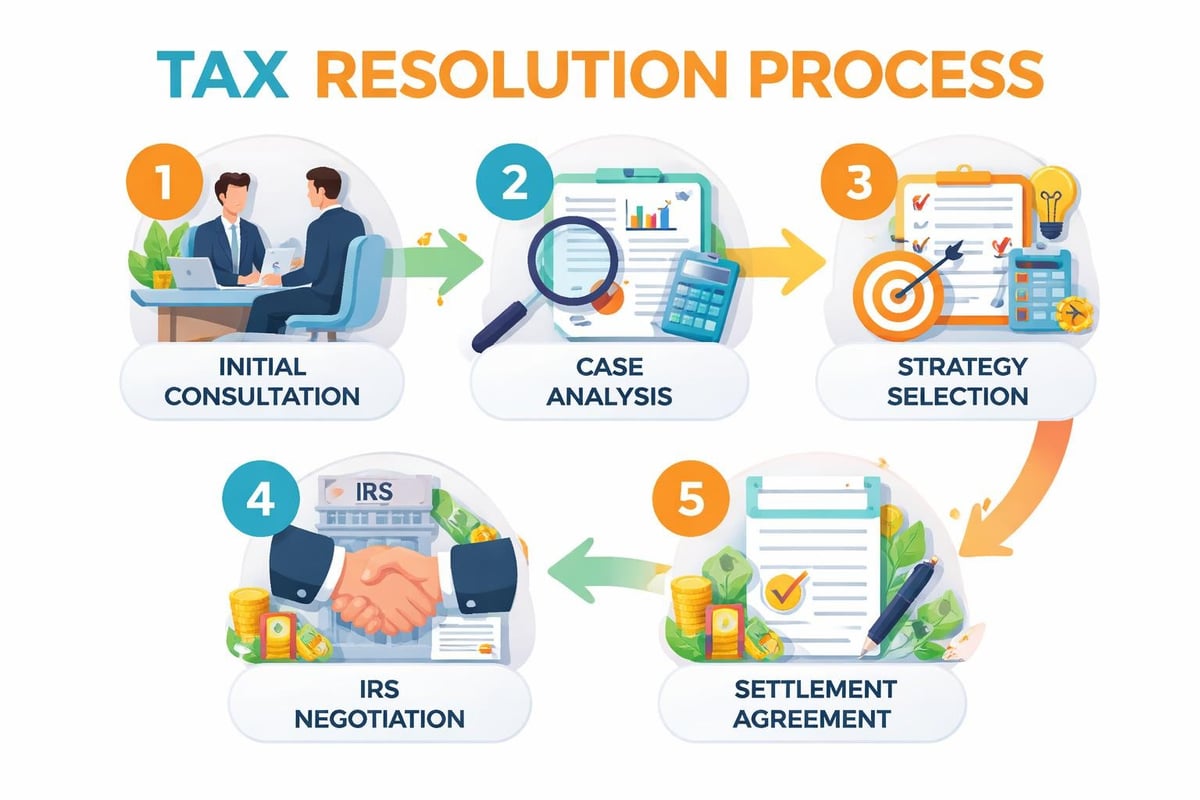
Initial Consultation and Case Analysis (1-2 Weeks)
The process begins with a comprehensive review of your tax situation. Professionals examine IRS transcripts, assessment records, and financial documentation to identify all issues and potential solutions.
During this phase, the tax resolution group should provide:
- Complete identification of all tax years and amounts owed
- Analysis of collection statute expiration dates
- Assessment of penalties that might be abated
- Evaluation of relief program eligibility
- Preliminary strategy recommendations
Strategy Implementation (1-6 Months)
Implementation timelines vary significantly based on the chosen strategy and IRS workload. Simple installment agreements may process within weeks, while complex Offers in Compromise can take several months.
Key milestones during implementation include:
- Gathering and organizing required financial documentation
- Preparing and submitting IRS applications or requests
- Responding to IRS information requests
- Negotiating terms and conditions
- Finalizing agreements and establishing compliance requirements
Mediation services sometimes accelerate resolution when disputes arise during negotiation. Experienced professionals know when to request mediation and how to prepare effective presentations.
Post-Resolution Compliance and Monitoring
Successful resolution requires ongoing compliance with agreement terms and future tax obligations. Most IRS settlements include provisions requiring timely filing and payment of taxes for a specified period, typically three to five years.
A reputable tax resolution group provides guidance for maintaining compliance and may offer ongoing monitoring services. Breaking agreement terms can reinstate the full original debt plus accumulated interest and penalties.
Cost Considerations and Investment Value
Professional tax resolution services represent a significant investment, and understanding fee structures helps taxpayers budget appropriately while avoiding predatory pricing.
Typical Fee Structures
Tax resolution groups employ various pricing models:
- Flat fees based on case complexity and estimated work hours
- Tiered pricing depending on debt amount and services required
- Hourly billing for ongoing representation or complex legal matters
- Hybrid models combining upfront fees with hourly charges for additional work
Average costs range from $2,500 to $10,000 for standard cases, with complex situations involving tax court litigation or criminal defense reaching $25,000 or more. These fees cover professional time, not the tax debt itself.
Calculating Return on Investment
Professional representation often saves far more than it costs. Consider these potential benefits:
| Benefit Category | Potential Savings |
|---|---|
| Penalty abatement | 25-40% of total debt |
| Reduced settlement amount | 40-90% of balance owed |
| Interest reduction | Varies by timeline |
| Avoided legal fees from litigation | $10,000-$50,000+ |
| Protected assets and income | Immeasurable |
The tax relief services provided by qualified professionals frequently result in settlements and payment arrangements that would be impossible to achieve independently. The expertise and IRS relationships that experienced practitioners bring justify the investment for most taxpayers facing substantial debt.
Payment Options and Financial Considerations
Many tax resolution groups offer payment plans to make their services more accessible. When evaluating affordability, remember that the alternative might be wage garnishment, bank levies, or property seizures that cause far greater financial harm.
Some providers offer free initial consultations, allowing you to understand your options without financial commitment. This consultation should provide clear information about potential strategies, realistic outcome expectations, and transparent pricing.
Protecting Yourself from Tax Resolution Scams
The tax resolution industry unfortunately attracts unethical operators who prey on desperate taxpayers. Understanding common scams helps you avoid costly mistakes and find legitimate help.
Common Deceptive Practices
Fraudulent tax resolution companies often use these tactics:
- Guaranteed outcomes before reviewing your financial situation
- Extremely low settlement promises without factual basis
- Large upfront fees before performing substantive work
- Pressure tactics demanding immediate decisions
- Unlicensed representatives claiming expertise they don't possess
Legitimate professionals acknowledge that outcomes depend on individual circumstances and IRS policies. They conduct thorough analysis before discussing probable results and clearly communicate both possibilities and limitations.
Verifying Credentials and Reputation
Before hiring any tax resolution group, verify credentials through appropriate licensing boards:
- Tax attorneys: Check state bar association websites for license status and disciplinary history
- Enrolled agents: Verify status through the IRS Directory of Federal Tax Return Preparers
- CPAs: Confirm licensing through state accountancy boards
Review online ratings and Better Business Bureau records, but recognize that some negative reviews come from unrealistic client expectations rather than poor service. Look for patterns in complaints and how the company responds.
Professional organizations like the American Society of Tax Problem Solvers provide additional credibility indicators. Membership in these organizations suggests commitment to ethical standards and ongoing education.
The Role of Technology in Modern Tax Resolution
Contemporary tax resolution groups leverage technology to improve efficiency, communication, and outcomes. Understanding these technological capabilities can inform your selection process.
Digital Document Management and Secure Communication
Modern practices utilize secure client portals for document exchange, protecting sensitive financial information while streamlining the collection of necessary paperwork. These systems allow real-time case status monitoring and reduce delays associated with traditional mail communication.
Key technological features include:
- Encrypted file sharing for tax returns and financial statements
- Automated IRS transcript retrieval systems
- Digital signature capabilities for quick document processing
- Mobile access to case information and updates
- Automated deadline tracking and reminder systems
Advanced Case Management Software
Sophisticated tax resolution groups employ specialized software that tracks collection statute expiration dates, calculates offer amounts, and models various resolution scenarios. This technology enables professionals to identify optimal strategies quickly and accurately.
The software also maintains detailed case histories, ensuring continuity when multiple team members work on a file. This systematic approach prevents oversights and ensures comprehensive representation.
Building a Long-Term Tax Compliance Strategy
Resolution of current tax problems represents only the first step. A comprehensive tax resolution group helps clients develop strategies to prevent future issues.
Proactive Tax Planning and Prevention
Forward-thinking professionals provide guidance on:
- Adjusting withholding or estimated tax payments to prevent underpayment
- Organizing financial records for accurate tax preparation
- Understanding tax implications of business decisions
- Identifying legitimate deductions and credits
- Structuring business entities for tax efficiency
This proactive approach transforms the client relationship from crisis management to strategic partnership. Regular consultation prevents many problems before they develop into serious tax debt.
Ongoing Monitoring and Support Services
Some tax resolution groups offer annual compliance monitoring to ensure clients meet their obligations and maintain good standing with tax authorities. These services might include:
- Annual tax return preparation and review
- Quarterly estimated tax calculations
- Payroll tax compliance monitoring for businesses
- Notification of IRS correspondence
- Immediate response to collection notices
The value of these ongoing services extends beyond technical tax compliance. The peace of mind knowing that experienced professionals monitor your situation and respond quickly to potential issues provides significant personal and business benefits.
Specialized Situations Requiring Expert Tax Resolution
Certain tax situations present unique complexities that demand specialized expertise within a tax resolution group.
Business Payroll Tax Issues
Unpaid payroll taxes trigger the most aggressive IRS collection actions. The Trust Fund Recovery Penalty personally holds business owners and responsible parties liable for the employee portion of withheld taxes.
A tax resolution group experienced in employment tax matters understands how to:
- Challenge Trust Fund Recovery Penalty assessments
- Negotiate settlements protecting personal assets
- Structure agreements allowing business continuity
- Navigate bankruptcy implications for payroll taxes
These cases often require specialized legal representation from attorneys who understand both tax law and business operations.
Criminal Tax Investigation Defense
When tax issues escalate to criminal investigation, the stakes increase dramatically. Criminal tax charges can result in imprisonment, substantial fines, and permanent criminal records.
Defense in these situations requires attorneys with specific criminal tax litigation experience. The tax resolution group must work collaboratively with criminal defense specialists to protect the client's liberty while resolving the underlying tax debt.
Warning signs of criminal investigation include:
- IRS Criminal Investigation Division contact
- Special agents visiting home or business
- Requests to discuss unfiled returns or unreported income
- Subpoenas for financial records
- Grand jury proceedings
Immediate legal representation becomes essential in these situations. Statements made without legal counsel present can create severe legal consequences.
International Tax Compliance and Offshore Account Issues
The IRS aggressively pursues taxpayers with unreported foreign income or undisclosed foreign accounts. Various voluntary disclosure programs allow taxpayers to come into compliance while potentially reducing penalties.
These complex situations require tax resolution groups with international tax expertise who understand:
- Foreign Account Tax Compliance Act (FATCA) requirements
- Foreign Bank Account Report (FBAR) filing obligations
- Streamlined filing compliance procedures
- Voluntary disclosure practice and procedures
- Tax treaty implications
The penalties for unreported foreign accounts can exceed the account balances themselves, making professional guidance critical for minimizing exposure.
Resolving tax debt requires professional expertise, strategic planning, and comprehensive understanding of IRS procedures and available relief programs. Working with a qualified tax resolution group provides the representation and advocacy necessary to achieve the best possible outcome while protecting your financial future. CLAW Tax Group offers experienced attorneys and tax professionals who specialize in helping individuals and businesses navigate complex tax situations, negotiate favorable settlements, and establish long-term compliance strategies. If you're struggling with tax debt or facing IRS collection actions, professional guidance can make the difference between financial recovery and ongoing hardship.



